Service Brochure
Contextual Account Targeting
Selecting the right targets is the first step to maximizing sales outcomes

Purpose
Target prioritisation aligned to the business environment.
Most target-account selections are made once and then left largely unchanged for months. Meanwhile, the business environment shifts: priorities move, leadership changes, financial capacity tightens or improves, and the timing for action changes with it.
Contextual Account Targeting keeps that target set current. It periodically reviews the change signals that matter, re-segments accounts against Culture, Strategy and Capital, and identifies where commercial effort is most likely to be well spent now.
Service deliverables
What the client receives.
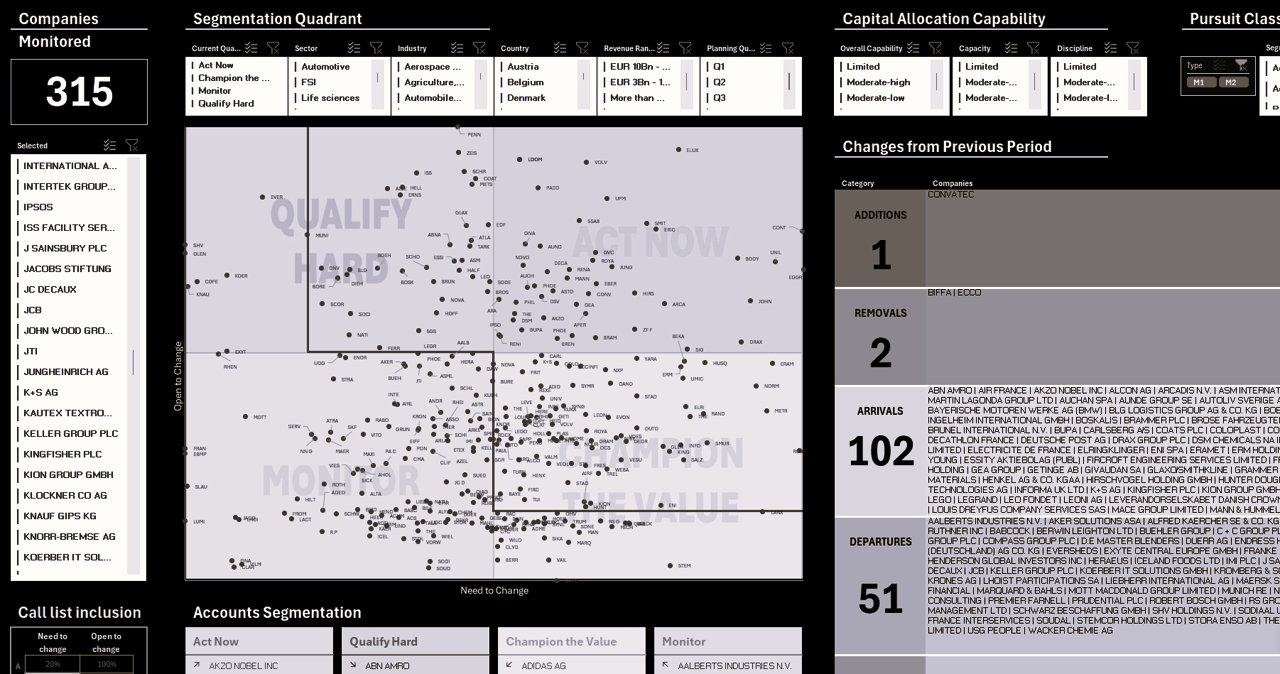
The service provides a dashboard showing the segmentation of the target universe, with multiple filters that allow the data to be sliced, compared and assessed from different angles. That gives a clearer view of the overall quality of the target list as well as the relative attractiveness of specific segments.
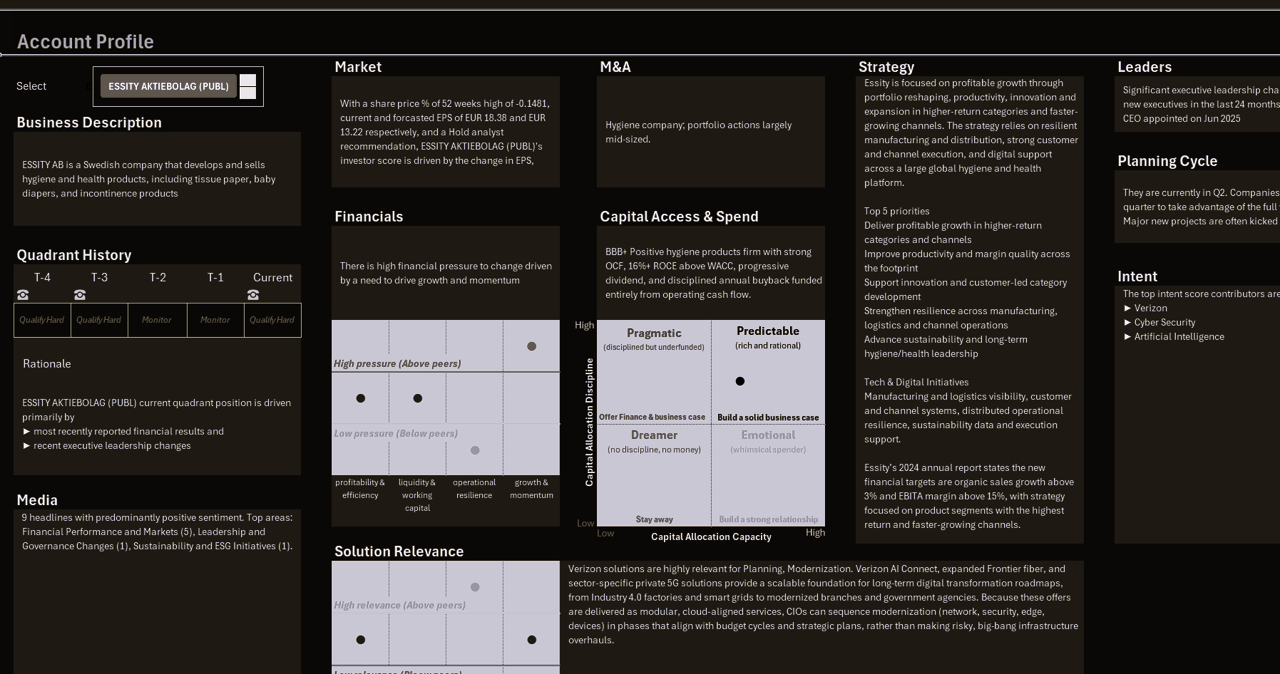
The client also receives individual profiles for each researched account and a recommended priority list that can be shared with outreach teams. Where additional support is required to approach those accounts, the work can be complemented by Strategic Engagement and Executive Access.
Client benefit
A better use of sales attention.
The result is a target set that reflects current conditions rather than historic assumptions. Sales resources can be directed toward accounts where the commercial case is more timely, more credible and more likely to justify engagement effort.
That reduces wasted pursuit, lowers the risk of poorly timed approaches and improves the odds of arriving before the opportunity is fully defined elsewhere.
Accounts are prioritised where openness to change, need to change and capacity to fund change align at the same time.
Contextual Account Targeting threshold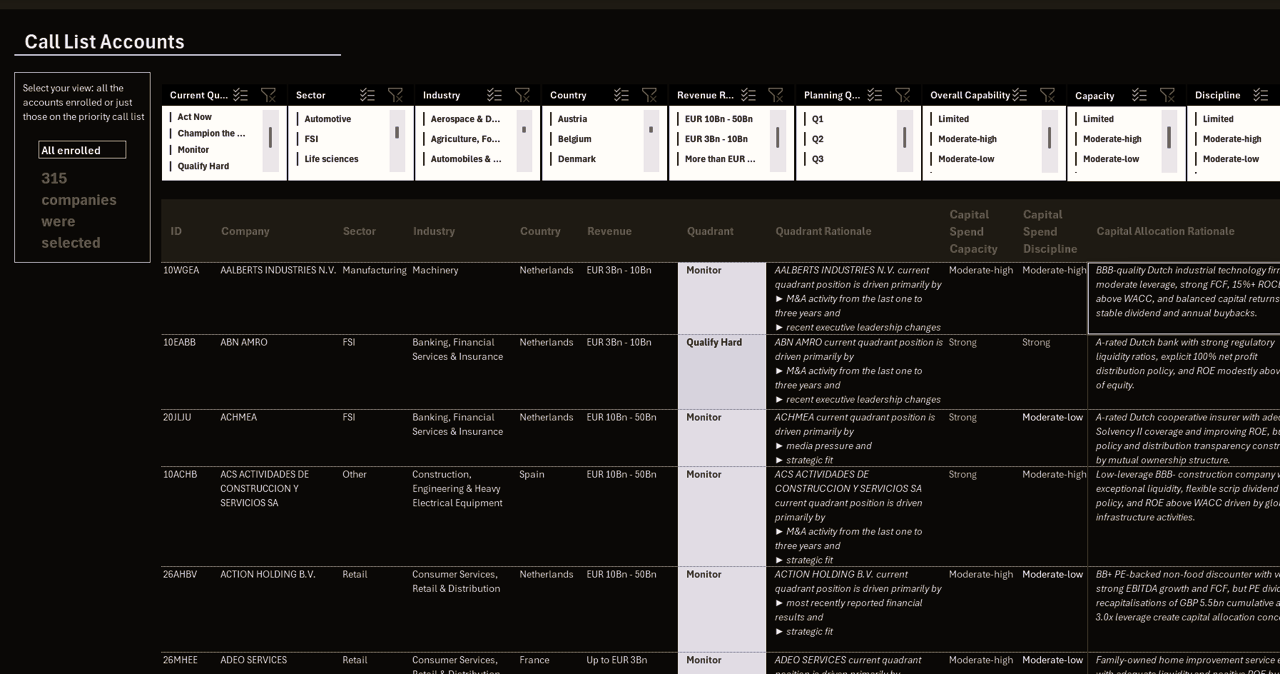
How it works
Segmentation built on monitored signals.
The service monitors a defined set of account-level indicators across financial performance, investor and market context, executive developments, strategic announcements, acquisitions, media coverage and other relevant external signals.
Those indicators are selected with the client so that the analysis stays anchored to the specific solution being taken to market. The objective is to understand whether the conditions for action are strengthening, weakening or remaining unchanged for a specific account in relation to that solution.
Interpretation based on three independent lenses.
Every account in scope is evaluated across three dimensions. The lenses are independent because readiness to act is only credible when an organisation is open to change, has a reason to change and can allocate capital to support the change.
Culture
Openness to change: leadership ethos, decision-making norms, change appetite and the degree to which the organisation is willing to challenge the status quo.
Strategy
Need to change: strategic direction, competitive pressures, regulatory exposure, operating priorities and other challenges the client can help with.
Capital
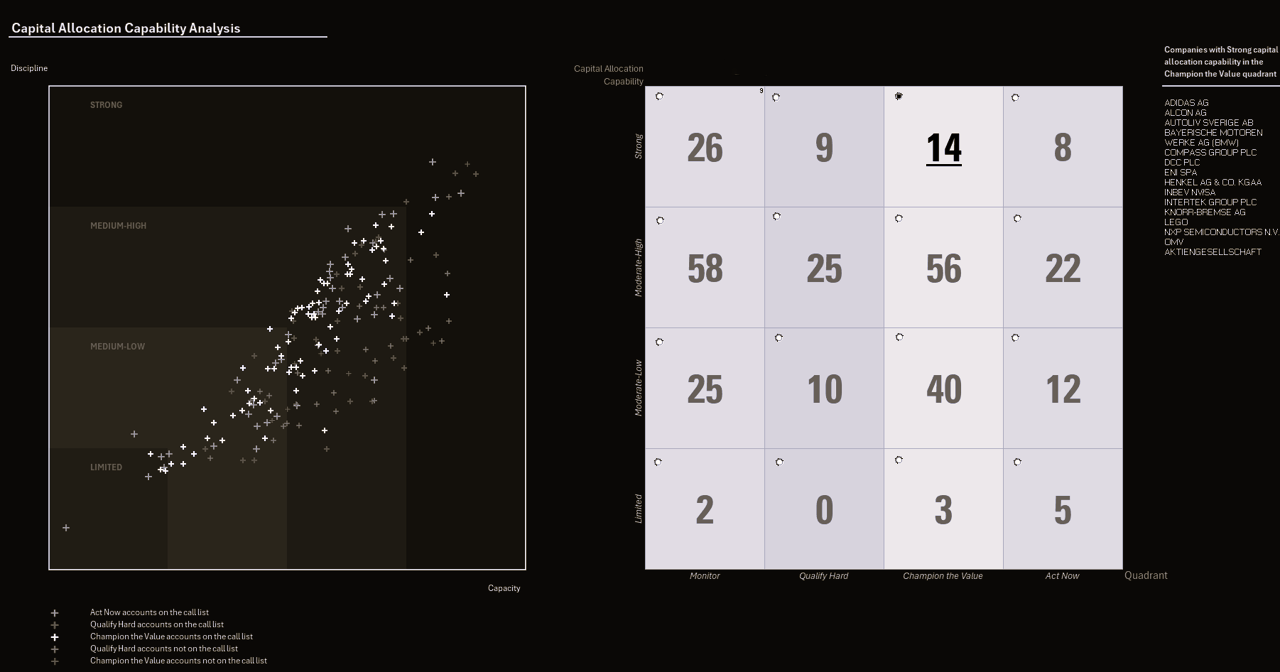
Capacity to fund change: whether the organisation could allocate capital to a justified project if persuaded of its merits, including where vendor finance may play a role.
Direction, magnitude and starting point all matter.
Financial change is assessed by more than movement alone. Direction and magnitude remain important, but the starting position is also material because it changes the meaning of the same movement across different businesses.
A deterioration from strong performance carries different implications from a deterioration starting from a weak base. Likewise, modest improvement from a constrained position may still be insufficient to support transformation at scale. That starting point helps determine the likely type, scale and urgency of change an organisation can realistically undertake.
Review frequency follows decision relevance.
As with the signals selected, the monitoring cadence is agreed with the client and tied directly to the client solution.
The recommendation is to set review intervals according to how often the underlying data can change, how long that change is likely to affect buying decisions, and how quickly action can realistically be taken.
Better targeting depends on recognising not just who fits a market profile, but who is becoming more ready to act, why that readiness is changing, and whether the organisation can fund the change once convinced.
Periphas Contextual Account Targeting